debtcare.ca

Author: mgoldenberg@debtcare.ca

  • What is a Consumer Proposal in Canada? Pro’s and Con’s

    Individuals and businesses in Canada are very fortunate to have many options available to them should they run into financial problems. One option that many individuals and businesses with unmanageable debt choose is a consumer proposal.

    What is a consumer proposal in Canada? Well, a consumer proposal is a legal option mandated by the Federal Government. It enables consumers and businesses to settle debt at much less than they owe, freeze interest and make a single monthly payment that is disbursed to their creditors.

    Generally, a consumer proposal becomes an option when individuals or businesses are bringing in much less income than they were at the time they took out credit. This could occur due to job loss, disability, divorce, or loss of contracts or business. Another scenario where a person may consider a consumer proposal is when he or she has racked up a lot of debt and is only making minimum monthly payments with no reasonable ability to pay off the overall debt. The common denominator is that debt has become unmanageable and the individual or business that is in debt needs debt relief.

    The single biggest “con” as it relates to a consumer proposal is the myth that it will hurt an individual’s credit. A consumer proposal will remain on an individual’s credit report for 3 years from the date it is paid in full. This is a non-issue where the party has already begun defaulting on money owed to creditors because he will have likely already damaged his credit for a long period of time. When an item goes into default on an individual’s credit, it will remain there for 6 years from the date it is paid in full.

    Consumer proposals offer many “pros”. First, a consumer proposal provides debt relief. Once a consumer proposal has been accepted, all creditors must stop any enforcement action being taken. Enforcements actions like frozen bank accounts and wage garnishments will be stopped immediately.

    Second, a consumer proposal involves settling debt for less than what was originally owed. Third, consumer proposals enable the individual or business who files to make a single monthly payment that is much less than what they had been paying prior to filing the consumer proposal.

    Trustees in Bankruptcy administer consumer proposals. This can pose a challenge because trustees act for the creditors involved in the proposal, in addition to the individual or business who is filing it. They are compensated based on the size of the consumer proposal they negotiate. These two factors can often result in the individual or business filing the consumer proposal not getting the best deal.

    How do you know that a consumer proposal is the best option to deal with your financial problem? There is no easy answer to this question. The right answer to your financial problem will depend on your personal circumstances. Determining the right choice will involve a detailed review of your assets, liabilities and budget.

    Financial consultants and debt counsellors who routinely arrange consumer proposals will be able to perform this review and because you pay them, you will be assured that you are receiving impartial advice and not a sales pitch. It may end up that a consumer proposal isn’t the best choice for you.

    For more information about this article topic “What is a Consumer Proposal in Canada” or to receive a review of your financial situation contact Michael Goldenberg at DebtCare Canada by calling 416 907 2582 or visit www.debtcare.ca
  • Debt Consolidation Options in Ontario – We List the Different Types of Debt Consolidations

    In Ontario, when consumers or businesses finds themselves in financial trouble there are a number of financial options available to help deal with their debt. In this article, we list the different types of debt consolidation to help you understand which options are available to you if you are having problems managing your debt.

    Debt consolidation option number one – use your home to consolidate debt. If you have some equity in your home, it is a very effective choice for consolidating debt. Refinancing your first mortgage, taking out a second mortgage or a home equity line of credit will enable you to obtain low  interest financing to consolidate your debt. Mortgages enable you to amortize your monthly payments so you will often have more flexibility when negotiating the amount of those payments.

    Debt consolidation option number two – an unsecured loan or line of credit. Where this option is concerned, do lots of research. There are finance companies that offer unsecured consolidation loans at sky-high interest rates. Interest rates that are higher than what you may be paying on your credit cards. They may try to sell you on the benefit of a single monthly payment, which may be lower than what you are paying now – but this could cost you big time in the long run. If you cannot pay your minimum monthly payments any longer and your bank does not approve you for a prime rate loan or line of credit to consolidate your debt, take time to think about your choices before jumping into a high interest consolidation loan with a finance company.

    Debt consolidation option number three – credit counselling. Credit counselling agencies are not for profit organizations who obtain funding from the big banks. They will offer you a single monthly payment and pay your debts on your behalf. While you may think that you have received a debt consolidation loan because you are making a single monthly payment, this is not a consolidation loan. Your creditors will receive significantly less than what you owe and these credit counselling programs will cause major damage to your credit report. The repayment could be over 5-6 years and the credit counselling program will be reported on your credit report for 3 years from the date it is paid in full.

    Debt consolidation option number four – consumer proposals. Like credit counselling this is not a consolidation loan but many trustees in bankruptcy promote them as though they are because they involve a single monthly payment lower than what you have been paying on a monthly basis. They are a better choice than a credit counselling program because, if negotiated properly, they can significantly reduce the overall amount of debt that you owe. Like credit counselling, a consumer proposal will stay on your credit report for 3 years from the date it is paid in full, however, they do often offer shorter repayment terms. They also offer you protection from your creditors and will stop a wage garnishment or other enforcement option because they are federally mandated whereas credit counselling is not.

    How do you know which debt consolidation option is the right one for you? For starters, consider a debt consolidation the same way you would a big ticket purchase. This truly is an example of buyer beware, because when you go to a bank, finance company, credit counselling agency or Bankruptcy Trustee, their objective will be to sell you their products and services. When working with a financial consultant or debt counsellor you can determine the right option and obtain professional guidance to secure the best outcome.

    For more information about debt consolidation options in Ontario or to obtain advice with respect to your personal financial situation contact Michael Goldenberg at DebtCare Canada by calling 416 907 2582 or visit www.debtcare.ca

  • Why do Debt Counsellors Charge a Fee for Debt Help in Ontario?

    Debt counsellors are not “not for profit” credit counselling agencies and are actually a form of financial consultant. This often gets misconstrued because credit counselling agencies promote debt help in Ontario; what is not known is the fact that they are largely funded by the major banks and are often not the right choice if you are struggling with a financial problem.

    Debt counsellors represent individuals and businesses that have problems managing their debt. They do charge a nominal fee for their services because they are not funded by anyone else. They represent you exclusively in whatever choice you make, as it relates to strategizing a way out of debt.

    When you visit a debt counsellor to get debt help in Ontario, she will review all of your financial information. This includes your income, assets, liabilities and budget. She will provide you with many scenarios for you to choose from, all designed to help you deal with your debt. These scenarios could include a new budget, a debt consolidation, a debt settlement, consumer proposal or, where necessary, a bankruptcy.

    Due to the fact that they do not administer bankruptcies and consumer proposals  the way Bankruptcy Trustees do, they will not recommend bankruptcy or a consumer proposal as an option unless it is absolutely necessary. Bankruptcy Trustees only make money if you file a bankruptcy or consumer proposal. In the case of a bankruptcy, they are paid a tariff out of the proceeds of the bankruptcy. In the case of a consumer proposal, they are paid a percentage of the consumer proposal. If you qualify for a consumer proposal or bankruptcy, they will arrange it for you; however, that doesn’t necessarily mean it is the best choice for you. It means that it is the only choice they can offer you based on the tools they have available to them.

    Debt counsellors charge a fee for debt help in Ontario because they will do a considerable amount of work while representing you and ensuring that you make the right choice for your situation. Bankruptcy Trustees do not represent you; they are officers appointed by the Superintendent of Bankruptcy to administer bankruptcies and consumer proposals. Their mandate is to administer a bankruptcy, ensuring that the creditor receives as much money as possible. While they may appear to represent you, because you sign your final paperwork with them and grant them legal status, they in fact are acting in the best interest of your creditors.

    This brings us to the next reason that debt counsellors charge a fee for debt help in Ontario. If it happens that a consumer proposal is the best choice for you, there are two major reasons that you benefit from being represented by a debt counsellor:

    1.       In the case of a consumer proposal, the Bankruptcy Trustee gets paid based on a percentage of the consumer proposal that they arrange for you. The more they can negotiate for you to repay your creditors, the more money they will earn. This means that you may not always end up with the best deal. A debt counsellor will help to negotiate lower consumer proposals in many cases. Lower than what you would have been offered had you gone to a Bankruptcy Trustee directly, which could save you thousands!

    2.       A Bankruptcy Trustee will almost always try to get you to file a consumer proposal, even if you also qualify for bankruptcy. In a bankruptcy, your creditors receive much less money and so does the Trustee. If they present you with a consumer proposal as an option, as opposed to a bankruptcy, they make more money. The problem is that if in fact you are insolvent, you will inevitably end up having problems making the payments required by the consumer proposal. The payments will last for a much longer length of time when compared to a bankruptcy.

    At the end of the day, if your debt has become unmanageable, it makes complete sense to obtain a financial opinion and even representation from an unbiased party. One who understands the world of finance in depth, thereby ensuring that you make responsible financial choices that protect your wallet.

    If you would like more information about why debt counsellors charge a fee for debt help in Ontario or if you are struggling financially, please contact Michael Goldenberg at DebtCare Canada by calling 416-907-2582 or visit www.debtcare.ca

  • What is a Bankruptcy Trustee in Ontario and What is Their Role in a Debt Restructuring?

    A Bankruptcy Trustee in Ontario plays an important role when it comes to debt restructuring. Bankruptcy Trustees across Canada are appointed by the Superintendent of Bankruptcy to oversee bankruptcy and consumer proposal filings in Ontario.

    It is important to understand what a bankruptcy trustee in Ontario is and what his role is with regard to debt restructuring before going to see one directly. The most significant fact that you need to be aware of is that the trustee administers the estate of the debtor as its legal representative, but his financial incentive when a bankruptcy or consumer proposal is filed is to maximize the return to the creditors.

    What does this mean to you? Well, when you go to see the Bankruptcy Trustee to make a full financial disclosure, it is no different than going to your creditor to make a financial disclosure. Keep in mind; the role of the Bankruptcy Trustee is to obtain the greatest possible amount of money from you, all to the benefit of your creditors.

    Bankruptcy and consumer proposals have, to some extent, become an industry of their own in Ontario. The Bankruptcy Trustee is a court-appointed officer and is supposed to take a neutral role in your bankruptcy or consumer proposal filing; however, they are frequently advertising in the mainstream media as a safe place for you to go for counsel when struggling with debt. This could not be further from the truth.

    The truth is, visiting a Bankruptcy Trustee is no different than speaking to the CRA directly about your tax problem without representation from an accountant or a tax lawyer.

    When you go to a Bankruptcy Trustee, he or she will ask for complete financial disclosure with regard to your income, assets and liabilities. They will try to find as much income and liquidity as possible to drive up the amount of your bankruptcy or consumer proposal, all to the benefit of your creditors. We surmise that in some cases, also to the benefit of their own fees.

    Another challenge is that in many cases a consumer will unwittingly omit information when they file for bankruptcy. The Bankruptcy Trustee will often accept whatever information you provide based on your word. Once the bankruptcy or consumer proposal has been filed, the trustee will then engage in a rigorous and determined process to validate your disclosures. If the trustee finds additional income or assets, he or she will adjust the amount of money that you have to pay. In the case of a bankruptcy, what begins as a predetermined length of repayment may snowball into a seemingly endless repayment. You will not be able to get discharged until you have paid the Bankruptcy Trustee all of the money that the trustee believes you owe.

    Just as there are accountants and tax lawyers who represent people when they have a tax problem, there are financial consultants who can represent you if you have a debt problem. They can prepare your information, educate you about your choices, administer your paperwork and hold your hand through the process of a bankruptcy or consumer proposal, ensuring that you get a fair deal that protects you.

    For more information about Bankruptcy Trustees in Ontario, their role in a debt restructuring or to get representation in a bankruptcy or consumer proposal please contact Michael Goldenberg at DebtCare Canada by calling 416-907-2582 or visit www.debtcare.ca

  • DebtCare Canada at The Financial Technology Tradeshow

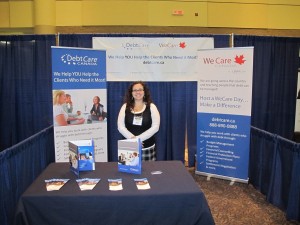
    We had a great time at The Financial Technology Tradeshow this past week. Thank you to everyone and it was a pleasure to connect with so many financial professionals. Here are our photos.


  • PRESS RELEASE – September 2011 – The WeCare Canada Initiative

    TORONTO SEPTEMBER 16, 2010 – DebtCare Canada, a Canadian financial consulting firm is announcing a new initiative, WeCare Canada, aimed to provide public education to help Canadians who struggle with debt.

    Through WeCare Canada, DebtCare Canada will be reaching into communities offering programs and resources to help families paralyzed by debt. DebtCare Canada offers families a wide range of tools and resources to deal with their debt. The solution could be a simple as a one-on-one counselling session with a Financial Counsellor and some re-budgeting. In more complex situations, individuals can gain help with financial restructuring and access to third party resources that may offer the solution to their financial problem.

    Through WeCare Canada, DebtCare Canada Financial Counsellors will be available to host “WeCare Days” at local community centres, places of worship and other agencies where the community congregates. On WeCare Days, The DebtCare Financial Advisor will offer free counselling sessions to individuals who chose to attend for help.

    In May of 2011 the Globe and Mail reported that based on Canada’s total household debt, that the average household debt per Canadian is $41,740. It is time that Canadians start to have a serious discussion about debt and the WeCare Canada initiative aims to start that discussion.

    As part of this announcement DebtCare is proud to announce that Karen Goldenberg has joined the DebtCare team as Director of Community Outreach. The former CEO of JVS Toronto, Karen brings extensive experience to the DebtCare Canada team having led successful private and non-profit charitable health, education and social service agencies. Karen will head up the WeCare Canada initiative with a mandate to build awareness of DebtCare’s continued mission to end the epidemic of personal over-indebtedness in Canada.

    If you would like more information about the WeCare Canada please contact Karen Goldenberg at 888-890-0888 to set up an appointment at your convenience. You can also visit www.debtcare.ca/wecarecanada or www.facebook.com/wecarecanada.

  • Exciting Announcement – Karen Goldenberg Joins the DebtCare Canada Team

    DebtCare Canada is proud to announce that Karen Goldenberg has joined the DebtCare team as Director of Community Outreach. Karen is the former CEO of JVS Toronto and brings extensive experience to the DebtCare Canada team having worked with community leaders and some of the most successful private and non-profit charitable health, education and social service agencies.

    Karen will head up the WeCare Canada initiative with a mandate to build awareness of DebtCare’s products, services and continued mission to end the epidemic of personal over-indebtedness in Canada.

    If you would like more information about the WeCare Canada initiative or if you would like to contact Karen, here is her contact information:

    Telephone: 888-890-0888 ext. 2587
    Email Address: kgoldenberg@debtcare.ca
    Online: www.debtcare.ca/wecarecanada
    Facebook: www.facebook.com/wecarecanada
    Blog: www.getinformed.ca


  • Debt warnings to Canadian households – Exploring the tips to manage the spiraling debt

    If your debt load is more than you have ever expected, you need not fret as you’re not alone. According to the Statistics Canada, the debt-to-income ratios of the Canadian households have reached record highs, ranging somewhere above 148%. This alarming figure shows that the Canadians owe $1.48 on every dollar of their disposable income that they have. If you’re one such Canadian, you need to take some solid steps that will help you lighten your overwhelmingly large load. The consumer debt crisis in Canada has been in the centre stage, it has been surveyed that the Canadian homeowners owe a whole of $1.5 trillion of debt. Though debt settlement can be a worthy option when it comes to repaying your debts, yet you must take some steps on your own to make sure that you manage this debt level that is soon spiraling out of control.

    Debt usually results from reckless spending habits and out-of-control usage of credit. It needs no mention that credit is important as it helps us purchase things that we cannot afford with money, yet too much usage of credit may lead you into high interest debt that can take a toll on your personal financial lives. Credit needs to be managed wisely so that it doesn’t become a burden on you. Following some simple personal finance management tips you can easily get a grip on your finances and thereby reduce your debt burden. Getting out of this spiraling debt level not only seems attainable but you may also feel rewarding. Have a look at the perfect recipe for a debt reduction plan.

    1. Study your monthly expenses: Make a list of your income and expenses so that you can ease off the pressure on your wallet. Create a monthly spending plan by implementing a frugal budget so that you can eliminate all the unnecessary expenses and concentrate only on the things that you need. Monitor your savings so that you can have enough funds to pay off your debts on time.

    2. Restrain the usage of your cards: Unless you restrain the usage of your credit cards, you can never see positive results in your debt life. The more you use credit while shopping for things, the more you dig yourself deeper into the debt hole. Lock your cards in your cupboard and carry cash while you go out. Stop shopping as soon as you exhaust your cash.

    3. Consolidate your debt: Having one monthly payment will be easier on your wallet than having to manage multiple payments in a month. Choose to consolidate your debts whether by signing up with a debt consolidation company or by taking out a debt consolidation loan. With minimized interest rate, debt repayment will become easier for you and you can let go of the thought of filing a bankruptcy.

    4. Choose to make bi-weekly payments: If you want to make debt more manageable, you have to explore the ways in which you can get debt free sooner. Paying bi-weekly means you need to make 26 payments instead of 12 payments in a year. If you pay more frequently, you have to pay lesser on interest rates and therefore you can become debt free sooner.

    5. Speak to a financial planner: A financial planner in Canada may help you take the best step towards your financial goal. Paying off credit card debt and consumer debt can become easier if you get help from a financial planner. He will tell you how to balance your income and expenses simultaneously.

    Pull out your credit report once in a month to confirm whether or not everything is being listed in it. Make needed changes to boost your score and remain creditworthy to your lenders. If needed, you can either consolidate your debts or go for debt settlement to repay your creditors on time.

  • Canadian bankruptcy filings fall as economy improves

    JANET McFARLAND
    From Saturday’s Globe and Mail
    Published Friday, Mar. 18, 2011 1:16PM EDT
    Last updated Friday, Mar. 18, 2011 5:21PM EDT

    Insolvencies dropped in Canada last year as consumers and businesses benefited from improving economic conditions to avoid bankruptcy.

    But the trend remains far worse than pre-recession levels, according to new data released Friday by the federal Office of the Superintendent of Bankruptcy, and the improvement comes from an especially weak base in 2009.

    Insolvencies fell 11.5 per cent in Canada in 2010, with 140,234 new cases filed compared with 158,441 cases in 2009. Consumers accounted for the vast majority of the cases – 135,008 last year, down 11 per cent from 151,712 in 2009. Business insolvencies dropped an even larger 22.3 per cent in 2010 to 5,226 cases from 6,729 cases in 2009.

    The bankruptcy superintendent defines insolvencies as both bankruptcies and formal agreements to settle debts, known as proposals.

    While trends were broadly positive in 2010, the volume of insolvencies still remains higher than pre-recession levels, the bankruptcy superintendent said.

    Insolvencies in 2010 were 20.6-per-cent higher than during the 12-month period ending September, 2008, just before the economic downturn began. Insolvencies spiked 29 per cent in 2009 to 158,441 cases compared with 123,234 cases in 2008.

    The figures showed some strengthening as the months progressed through 2010, however, with December insolvencies falling almost 17 per cent from November levels.

    Bankruptcy trustee Marvin Zweig, senior vice-president at accounting firm Meyers Norris Penny Ltd., said he is not yet convinced there has been a broad turnaround in insolvencies in Canada.

    He said a flood of new companies have emerged offering to help consumers informally restructure their debts. Their work may be deferring or delaying formal bankruptcy or proposal filings, Mr. Zweig said, but it still means many people are essentially insolvent.

    “I think the results are worse than the numbers are showing,” he said. “I think there are a lot of people who are insolvent and are going through a process to deal with their debts, but they aren’t necessarily at this time filing assignments in bankruptcy or proposals.”

    Mr. Zweig said the new debt-restructuring firms are especially active in the Toronto area, which he believes helps account for some of the drop in cases recorded in Ontario last year.

    Ontario saw the biggest improvement last year, with total insolvencies dropping 16 per cent as hard-hit manufacturing and other sectors posted improvements. Ontario insolvencies fell to 58,479 cases from 69,494 in 2009.

    Prince Edward Island was the only province to record an increase last year, with insolvencies climbing to 598 cases from 577 in 2009.

    Mr. Zweig said he is still seeing a large number of seniors among those filing for bankruptcy, with many living on government pension allowances and using their credit cards for necessities like food and clothing.

    A 2006 study funded by the Office of the Superintendent of Bankruptcy concluded seniors are the fastest growing category of personal bankruptcies in Canada, accounting for one in nine new filings.

    “I’m certainly seeing it in my practice,” Mr. Zweig said. “Unfortunately a lot of people when they retire are forced to live on government pension, and unfortunately it doesn’t cut it and they start to rely on their credit cards … They can only go so long in juggling the minimum payments, and eventually they have no choice but to deal with their debt.”

    The latest figures also show the impact of new rules introduced in September, 2009, that have shifted the balance between bankruptcy filings and restructuring proposals.

    The bankruptcy superintendent said 43,268 consumers filed debt-restructuring proposals in 2010, up 18 per cent from 36,640 cases in 2009.

    Many people who might have filed for bankruptcy in the past to clear their debts are now opting for restructuring because bankruptcy standards have been toughened, especially for people who are deemed to have surplus income when they are insolvent, Mr. Zweig said.

    Restructuring proposals allow debtors – including individuals with debts under $250,000 – a greater ability to settle their obligations while retaining assets and avoiding the black mark of a bankruptcy on their files. A bankruptcy filing stays on an individual’s credit record for longer than a proposal.